
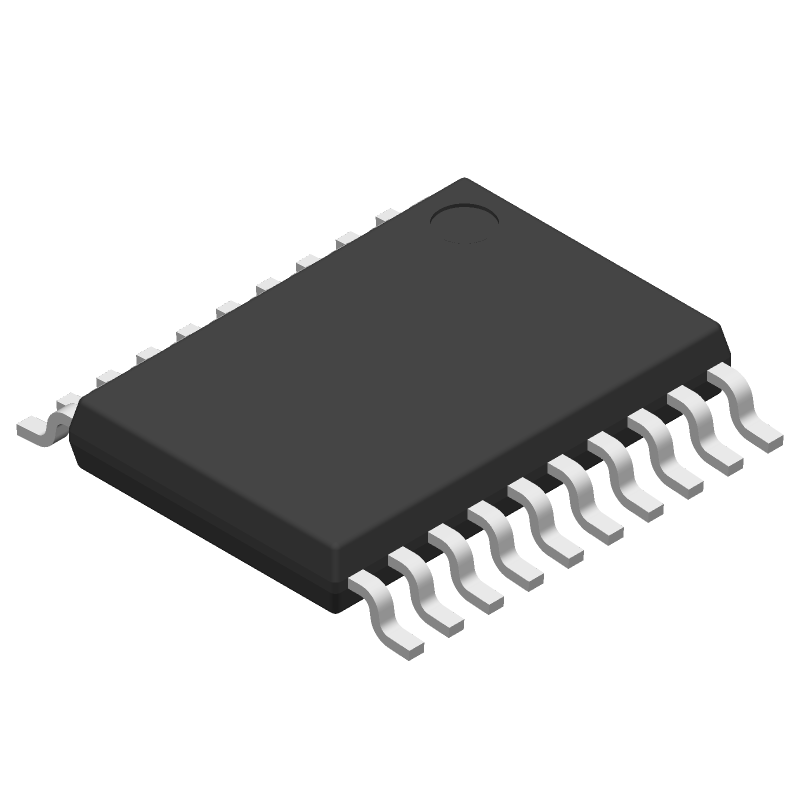
| Part Number | Manufacturer | Composite Price | Description | Compare |
|---|---|---|---|---|
| CDC906PWG4 | Texas Instruments | Check for Price | Clock Generator, 54MHz, CMOS, PDSO20 | CDC906PW vs CDC906PWG4 |
Part Details for CDC906PW by Texas Instruments
Results Overview of CDC906PW by Texas Instruments
- Distributor Offerings: (4 listings)
- Number of FFF Equivalents: (1 replacement)
- Tariff Estimator: (Available) NEW
- Number of Functional Equivalents: (1 option)
- CAD Models: (Available)
- Part Data Attributes: (Available)
- Reference Designs: (Not Available)
Tip: Data for a part may vary between manufacturers. You can filter for manufacturers on the top of the page next to the part image and part number.
CDC906PW Information
CDC906PW by Texas Instruments is a Clock Generator.
Clock Generators are under the broader part category of Microcontrollers and Processors.
Microcontrollers (MCUs) are small, low-power integrated circuits used to control embedded systems. Microcontrollers are primarily used to automate and control devices. Read more about Microcontrollers and Processors on our Microcontrollers and Processors part category page.
Available Datasheets
| Part # | Manufacturer | Description | Datasheet |
|---|---|---|---|
| CDC906PWR | Texas Instruments | Custom Programmed 3-PLL Clock Synthesizer / Multiplier / Divider 20-TSSOP | |
| CDC906PWRG4 | Texas Instruments | Custom Programmed 3-PLL Clock Synthesizer / Multiplier / Divider 20-TSSOP | |
| CDC906PW | Texas Instruments | Custom Programmed 3-PLL Clock Synthesizer / Multiplier / Divider 20-TSSOP |
Price & Stock for CDC906PW
| Part # | Distributor | Description | Stock | Price | Buy | |
|---|---|---|---|---|---|---|
|
DISTI #
296-21382-5-ND
|
DigiKey | IC PLL FREQ SYNTH 20TSSOP Min Qty: 210 Container: Tube |
0 Tube |
|
$7.0255 | Buy Now |
|
DISTI #
595-CDC906PW
|
Mouser Electronics | Clock Synthesizer / Jitter Cleaner Custom Prog 3-PLL Cl ock A 595-CDC906PWR A 595-CDC906PWR RoHS: Compliant | 5 |
|
$7.0300 / $10.6400 | Buy Now |
|
|
Rochester Electronics | Clock Generators and Synthesizers Clock Synthesizer 300MHz 20-SOP Tube RoHS: Compliant Status: Not Recommended for New Designs Min Qty: 1 | 4 |
|
$3.1700 / $3.9600 | Buy Now |
|
|
Vyrian | Clock Generator, 54MHz, CMOS, PDSO20 | 5875 |
|
RFQ |
US Tariff Estimator: CDC906PW by Texas Instruments
Calculations from this tool are estimations only for imports into the United States. Please refer to the distributor or manufacturer and reference official US government sources and authorities to verify any final purchase costs.
CDC906PW CAD Models
-
Part Symbol
-
Footprint
-
3D Model
Available Download Formats
By downloading CAD models, you agree to our Terms & Conditions and Privacy Policy
CDC906PW Part Data Attributes
|
|
CDC906PW
Texas Instruments
Buy Now
Datasheet
|
Compare Parts:
CDC906PW
Texas Instruments
Clock Generator, 54MHz, CMOS, PDSO20
|
| Pbfree Code | Yes | |
| Rohs Code | Yes | |
| Part Life Cycle Code | Not Recommended | |
| Part Package Code | TSSOP | |
| Pin Count | 20 | |
| ECCN Code | EAR99 | |
| HTS Code | 8542.39.00.90 | |
| JESD-30 Code | R-PDSO-G20 | |
| JESD-609 Code | e4 | |
| Length | 6.5 Mm | |
| Moisture Sensitivity Level | 1 | |
| Number of Terminals | 20 | |
| Operating Temperature-Max | 70 °C | |
| Operating Temperature-Min | ||
| Output Clock Frequency-Max | 54 Mhz | |
| Package Body Material | Plastic/Epoxy | |
| Package Code | TSSOP | |
| Package Equivalence Code | TSSOP20,.25 | |
| Package Shape | Rectangular | |
| Package Style | Small Outline, Thin Profile, Shrink Pitch | |
| Peak Reflow Temperature (Cel) | 260 | |
| Primary Clock/Crystal Frequency-Nom | 54 Mhz | |
| Qualification Status | Not Qualified | |
| Seated Height-Max | 1.2 Mm | |
| Supply Current-Max | 115 Ma | |
| Supply Voltage-Max | 3.6 V | |
| Supply Voltage-Min | 3 V | |
| Supply Voltage-Nom | 3.3 V | |
| Surface Mount | Yes | |
| Technology | Cmos | |
| Temperature Grade | Commercial | |
| Terminal Finish | Nickel/Palladium/Gold (Ni/Pd/Au) | |
| Terminal Form | Gull Wing | |
| Terminal Pitch | 0.65 Mm | |
| Terminal Position | Dual | |
| Time@Peak Reflow Temperature-Max (s) | 30 | |
| Width | 4.4 Mm | |
| uPs/uCs/Peripheral ICs Type | Clock Generator, Other |
Alternate Parts for CDC906PW
This table gives cross-reference parts and alternative options found for CDC906PW. The Form Fit Function (FFF) tab will give you the options that are more likely to serve as direct pin-to-pin alternates or drop-in parts. The Functional Equivalents tab will give you options that are likely to match the same function of CDC906PW, but it may not fit your design. Always verify details of parts you are evaluating, as these parts are offered as suggestions for what you are looking for and are not guaranteed.
CDC906PW Frequently Asked Questions (FAQ)
-
The recommended power-up sequence is to apply VCC first, followed by VDD, and then the clock signal. This ensures proper initialization and prevents potential latch-up conditions.
-
When using the CDC906PW in a PLL application, it's essential to ensure the clock signal is clean and stable. Use a clock buffer or a dedicated clock generator to provide a low-jitter clock signal, and consider adding a clock filter to remove any high-frequency noise.
-
While the datasheet specifies a maximum frequency of 100 MHz, the actual frequency limit may vary depending on the specific application, board layout, and signal integrity. As a general rule, it's recommended to derate the frequency by 10-20% to ensure reliable operation.
-
To minimize power consumption, ensure that the input signals are properly terminated, and use a low-power clock source. Additionally, consider using a lower supply voltage (VCC) and reducing the output load capacitance. You can also use the device's built-in power-down mode to further reduce power consumption when not in use.
-
When designing the PCB layout, ensure that the clock signal traces are short, direct, and well-shielded to minimize signal degradation and noise coupling. Keep the power supply traces separate from the signal traces, and use a solid ground plane to reduce electromagnetic interference (EMI).