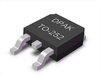
Part Details for STD2NM60T4 by STMicroelectronics
Results Overview of STD2NM60T4 by STMicroelectronics
- Distributor Offerings: (1 listing)
- Number of FFF Equivalents: (0 replacements)
- Tariff Estimator: (Not Available)
- Number of Functional Equivalents: (0 options)
- CAD Models: (Request Part)
- Part Data Attributes: (Available)
- Reference Designs: (Not Available)
Tip: Data for a part may vary between manufacturers. You can filter for manufacturers on the top of the page next to the part image and part number.
STD2NM60T4 Information
STD2NM60T4 by STMicroelectronics is a Power Field-Effect Transistor.
Power Field-Effect Transistors are under the broader part category of Transistors.
A transistor is a small semiconductor device used to amplify, control, or create electrical signals. When selecting a transistor, factors such as voltage, current rating, gain, and power dissipation must be considered, with common types. Read more about Transistors on our Transistors part category page.
Price & Stock for STD2NM60T4
| Part # | Distributor | Description | Stock | Price | Buy | |
|---|---|---|---|---|---|---|
|
|
Vyrian | Power Field-Effect Transistor, 2A I(D), 600V, 3.2ohm, 1-Element, N-Channel, Silicon, Metal-oxide Semiconductor FET, TO-252 | 8690 |
|
RFQ |
STD2NM60T4 Part Data Attributes
|
|
STD2NM60T4
STMicroelectronics
Buy Now
Datasheet
|
Compare Parts:
STD2NM60T4
STMicroelectronics
Power Field-Effect Transistor, 2A I(D), 600V, 3.2ohm, 1-Element, N-Channel, Silicon, Metal-oxide Semiconductor FET, TO-252
|
| Rohs Code | Yes | |
| Part Life Cycle Code | Obsolete | |
| Part Package Code | TO-252 | |
| Package Description | Dpak-3 | |
| Pin Count | 3 | |
| ECCN Code | EAR99 | |
| Avalanche Energy Rating (Eas) | 250 Mj | |
| Configuration | Single With Built-In Diode | |
| DS Breakdown Voltage-Min | 600 V | |
| Drain Current-Max (ID) | 2 A | |
| Drain-source On Resistance-Max | 3.2 Ω | |
| FET Technology | Metal-Oxide Semiconductor | |
| Feedback Cap-Max (Crss) | 4 Pf | |
| JEDEC-95 Code | TO-252 | |
| JESD-30 Code | R-PSSO-G2 | |
| JESD-609 Code | e3 | |
| Moisture Sensitivity Level | 1 | |
| Number of Elements | 1 | |
| Number of Terminals | 2 | |
| Operating Mode | Enhancement Mode | |
| Operating Temperature-Max | 150 °C | |
| Package Body Material | Plastic/Epoxy | |
| Package Shape | Rectangular | |
| Package Style | Small Outline | |
| Polarity/Channel Type | N-Channel | |
| Power Dissipation-Max (Abs) | 46 W | |
| Pulsed Drain Current-Max (IDM) | 8 A | |
| Qualification Status | Not Qualified | |
| Surface Mount | Yes | |
| Terminal Finish | Matte Tin (Sn) | |
| Terminal Form | Gull Wing | |
| Terminal Position | Single | |
| Transistor Application | Switching | |
| Transistor Element Material | Silicon |
STD2NM60T4 Frequently Asked Questions (FAQ)
-
The maximum operating temperature range for STD2NM60T4 is -40°C to 150°C, as specified in the datasheet. However, it's recommended to operate within -40°C to 125°C for optimal performance and reliability.
-
To ensure proper biasing, follow the recommended operating conditions in the datasheet. Typically, this includes a VCC supply voltage between 10V to 20V, a VGS threshold voltage around 4V, and a ID current limit of 2A. Additionally, ensure the device is properly heatsinked to maintain a safe junction temperature.
-
For optimal thermal management, use a multi-layer PCB with a solid ground plane and a thermal relief pattern under the device. Ensure a low thermal resistance path from the device to the heat sink or thermal pad. A minimum of 2oz copper thickness is recommended. Follow STMicroelectronics' application notes and layout guidelines for more information.
-
Implement overvoltage protection (OVP) and overcurrent protection (OCP) circuits to prevent damage from voltage spikes and excessive current. Use a voltage regulator or a TVS diode for OVP, and a current sense resistor or a dedicated OCP IC for current limiting. Ensure the protection circuits are designed to respond quickly to fault conditions.
-
Handle the STD2NM60T4 with care to prevent electrostatic discharge (ESD) damage. Use an ESD wrist strap or mat, and ensure the workspace is ESD-safe. Avoid touching the device pins or handling the device in close proximity to ESD-generating materials. Follow STMicroelectronics' ESD handling guidelines for more information.